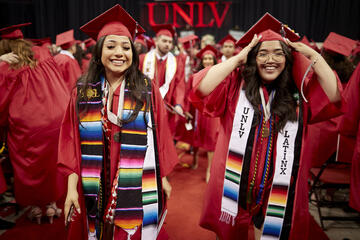
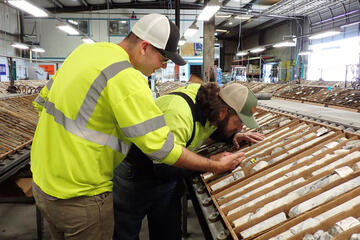
As the central organizational and support system for graduate students, the Graduate College has, over the years, played an important role in recruiting top students, supporting research, and cultivating a national reputation for UNLV. Although the university offered some graduate courses in the 1950s, it was not until 1964 that Nevada Southern officially established graduate education with the Division of Graduate Studies. Under the leadership of Charles Adams, professor of English and coordinator of graduate studies, the newly established division provided graduate classes designed to meet the growing needs of both Nevada and the region.
Graduate Growth
In 1967, the first group of students graduated with master's
degrees — nine from the School of Education and two from the School
of Science and Mathematics. Several new graduate degree programs were
particularly relevant to residents of Southern Nevada:
From Division to College
In 1972, the division became the Graduate College, with theater professor
Lawrence Kuhl serving as its founding dean. At the time of his appointment,
the graduate degree programs offered had increased to include the
master of arts in economics, French, German, Spanish, history, political
science, and psychology; the master of education in physical education;
the specialist in education; and master of science in mathematics.
Dramatic Growth
By 1977, more than 1,600 graduate degrees had been conferred. That
year, five of the 262 candidates for graduate degrees received the
first doctor of education degrees conferred by the university. By
1984, graduate enrollment had grown to more than 700, and 30 graduate
degree programs were offered. This period was followed by a decade
of dramatic growth for the entire university, reflected in enrollment
and program growth in the Graduate College.
Importance of Research
Research is the cornerstone of graduate education. From its earliest
days, the Graduate College has supported graduate-level research
and continues to encourage graduate students to pursue scholarly
and creative activity. In 2002, an administrative reorganization
integrated the Graduate College with campus research units to form
the Division of Research and Graduate Studies. This strategic move
will further the current university goal of strengthening research
by enhancing the graduate studies that support it.
Preparing Leaders
Graduate education plays an integral role in preparing leaders in society.
Today, more than 6,000 graduate and professional students are enrolled
at UNLV. Nearly 120 graduate-level programs — including 36 doctoral
and professional programs — are offered, representing a wide
variety of disciplines. More than 16,000 graduate degrees have been
conferred since 1967, including nearly 500 doctorates.
In the years ahead, the college will continue its mission: to support and advance high-quality graduate education and research; strategically develop graduate programs; support graduate faculty; encourage superior mentorship; and train and graduate students and scholars who contribute regionally, nationally, and internationally.
Deans
1972 — Lawrence Kuhl
1977 — Joe McCullough, interim
1980 — James F. Adams
1985 — Ronald Smith
1998 — Penny Amy, interim
1999 — Paul Ferguson
2003 — Gale Sinatra, interim
2006 — Mark Rudin, Interim Vice President for Research and Graduate
Dean
2006 — Ron Smith, Interim Vice President for Research and Graduate
Dean